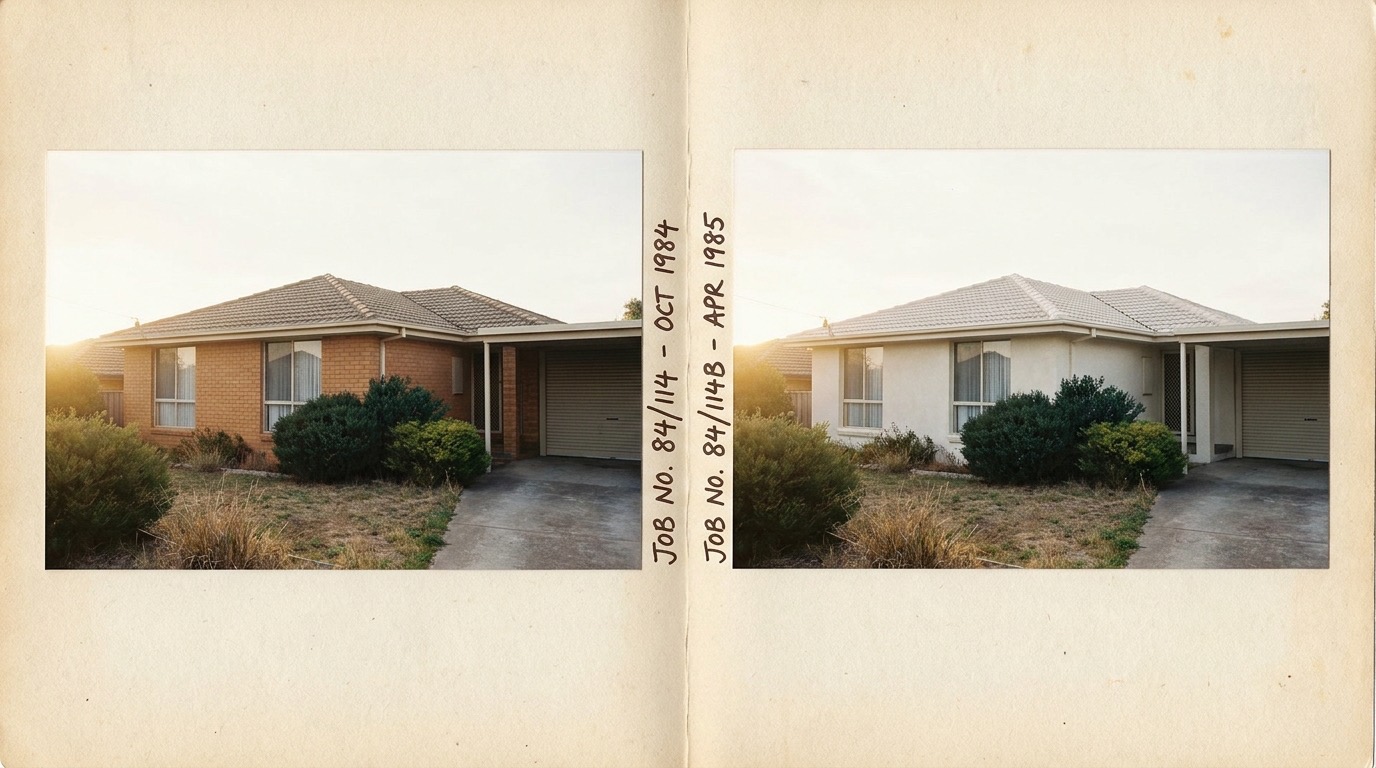
What actually happens to the brick
Limewash is slaked lime mixed with water and mineral pigment, brushed straight onto the brick in thin coats. It's not paint in the acrylic sense. There's no plastic film sitting on the surface. The lime carbonates as it dries and becomes part of the wall's outer layer, which is why it can be washed and touched up without peeling the way a painted brick job eventually does.
For most Ballarat homes this means the original brick colour and texture still show through, just softened and evened out. You can still see mortar lines, still see individual bricks. It reads as a finish, not a cover-up.
Why brick veneer suits this particular treatment
A lot of Ballarat's housing stock from the 1970s through 90s is brick veneer that was never meant to be a design feature, it was just what got built. Orange-brown or mismatched brick that made sense at the time reads dated now, and a full render job to fix it usually means $25,000 upward once scaffolding, cement board, and finishing coats are all in. Limewash gets a comparable street-appeal result at roughly a third to half that cost, because you're working with the existing brick instead of covering it.
It also suits Ballarat's climate better than people expect. The lime finish is vapour-permeable, so moisture that gets into the brick from rain or ground damp can still escape outward rather than getting trapped behind a sealed acrylic coat. On older brick especially, trapped moisture behind a non-breathable paint is what eventually causes blistering and spalling. Limewash avoids that problem by design.
What the job actually involves
Inspection and quote. The specialist looks at the brick condition, existing paint if there is any, mortar joint condition, and access (single storey versus double storey changes the scaffolding needs significantly). This is always done on-site, not from photos, because prep requirements vary more than most homeowners expect.
Washing and repair. The wall gets a proper wash to remove built-up grime, efflorescence and any loose or flaking material. Any damaged mortar gets repointed before limewash goes anywhere near it, since lime won't hide a structural or moisture problem, it'll just show it more clearly.
Sealing, if needed. Previously painted brick needs a mineral primer coat first so the limewash has something consistent to bond to. Raw, never-painted brick usually doesn't need this step and takes the lime directly.
The coats. Three to four thin coats, applied by brush rather than roller or spray, with drying time between each. This is the part that separates a good limewash job from a patchy one. Rushing the coats or applying them too thick is the most common way this finish goes wrong, and it's why a proper job doesn't run on a same-week turnaround.
Final walkthrough. The finish gets checked with you in morning and afternoon light before it's called done, since limewash can read differently depending on the angle and time of day, which is part of its appeal but also something worth seeing before final sign-off.
Cost, honestly
Exterior limewashing in the Ballarat area runs roughly $45 to $70 per square metre, against $35 to $55 for a standard exterior repaint. The gap reflects labour, not material, since the lime itself is genuinely cheap. What costs money is the multiple thin hand-applied coats and the drying time between them, which can't really be sped up without compromising the finish.
For a typical single-storey brick facade, that puts most jobs between $9,000 and $20,000 depending on wall area, brick condition, and access. Double storey homes add scaffolding cost on top, usually a 40 to 60 percent uplift over the single storey figure for the same wall area.
Pricing needs an on-site look rather than a phone estimate. A rough square metre rate is useful for budgeting, but the real driver of price is how much prep the brick needs, and that's something that can only be assessed in person.
Limewash versus rendering versus repainting
Rendering covers the brick entirely with a cement or acrylic layer, gives you a completely flat modern look, and costs considerably more. It's the right call if you want to change the wall's texture entirely, not just its tone. Repainting with standard exterior acrylic is cheaper up front but seals the brick, which isn't ideal on older or damp-prone walls, and tends to need full repainting again in eight to ten years once it starts to chip or peel. Limewash sits between the two: cheaper than render, more breathable and longer-lived in practice than paint, and it keeps the brick reading as brick rather than as a painted surface.